Got tired of climbing into the bed to get at anything sitting up against the midgate. The Avalanche bed is short enough that you can nearly reach the front of it from the tailgate, which is exactly the distance that puts your back out, and the factory side boxes take a bite out of the floor on both sides.
So instead of buying a cargo slide, I built one. Built not bought.
Full video:
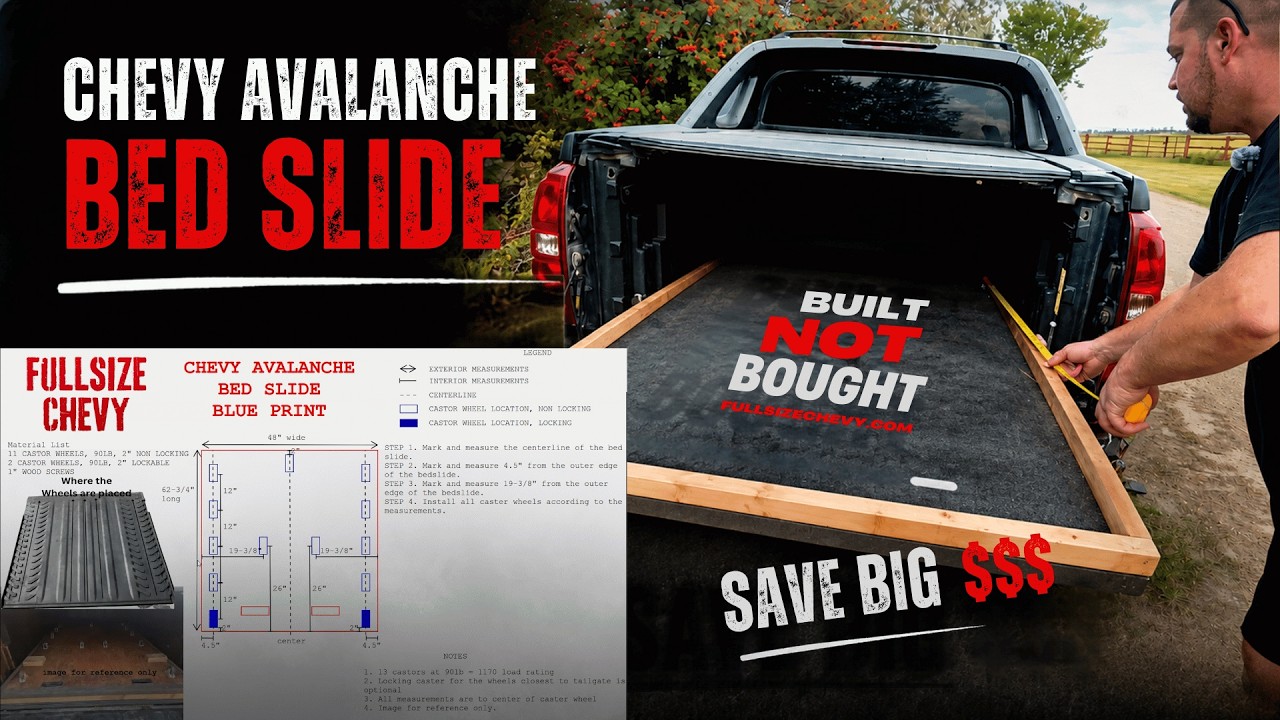
Blueprint PDF — download it here. Two pages: the platform and frame on page 1, the caster layout on page 2. Everything below is on it, so you don’t need to watch the video to build this.
Full write-up with all the tables: DIY Chevy Avalanche Bed Slide
The idea
A plywood platform on casters that rolls out over the tailgate, so the cargo comes to you instead of you going in after it. Mine is custom built from scratch around the bed.
Worth knowing if you’d rather not start with a fresh sheet: the Avalanche bed isn’t far off a lot of the newer midsize beds — Tacoma, the new Ranger, Colorado/Canyon. If a used wooden bed slide turns up for sale near you, you can generally cut one of those down to fit instead of building from nothing.
The basic specs
| Platform | 48" x 62-3/4" |
| Material | Nominal 1" marine grade plywood |
| Frame | 1x1 treated, perimeter, underside |
| Casters | 13 total, 2", 90 lb |
| Locking | 2, at the tailgate end |
| Top | Carpeted, 62" x 76-3/4" piece |
| Handles | 2 openings, 2" x 6" |
Build
1. Measure your bed first. Width at the narrowest point — that’s between the side boxes, not down at the floor. Midgate to closed tailgate. Wheelhouse intrusion. Rib height and spacing if you’ve got a liner, because 2" wheels either ride the tops or drop into the valleys. These numbers came off my truck and bedliners vary — measure your own before you cut plywood. If yours come in tighter than mine, cut to your numbers; the caster layout scales off the edges so a smaller sheet doesn’t break it.
2. Cut the sheet. 62-3/4" off the length of a 4x8, full 48" width. Mark the tailgate end and the top face right away, the caster layout isn’t symmetrical. Seal the edges.
3. Frame. Two 1x1s at 48" for the ends, two at 61-1/4" for the sides. One of each out of each 10 ft length. Note the 61-1/4" only works because 1x1 is actually 3/4" — 62-3/4 minus two 3/4" cross members. If your stock measures a true 1", it’s 60-3/4".
4. Glue and screw it. PL 400 and 1-1/2" exterior screws about every 8", predrilled and countersunk. Watch your screw length. 3/4" of frame plus a 1-1/2" screw is already 3/4" into a sheet that might only measure 3/4". The whole stack is 1-3/4" at most, so anything approaching 2" comes out one side or the other.
5. Handles (optional). Two 2" x 6" openings, 4" from the tailgate edge, 18" in from each side. Lay them out and eyeball it before you drill — those callouts put them tight together at the centre and you might want them further apart. Round the edges properly, you’ll be pulling on them with gloves.
6. Carpet. Trowel the glue, lay the carpet, wrap the 7" of overhang under all four edges and staple it. Weight it down and let it cure properly before flipping.
7. Casters last. Layout below.
Caster layout
All to the centre of the caster. x from the driver edge, y from the tailgate edge.
| Position | x | y |
|---|---|---|
| Driver outer track | 4-1/2" | 2", 14", 26", 38", 50" |
| Passenger outer track | 43-1/2" | 2", 14", 26", 38", 50" |
| Interior pair | 19-3/8" and 28-5/8" | 26" |
| Centre, cab end | 24" | 60-3/4" |
Thirteen total. The two at y = 2", closest to the tailgate, are the locking ones. Page 2 of the blueprint has the same thing drawn out if you’d rather work off the picture. Strike the two 4-1/2" lines and the centreline first and the rest falls out of a tape measure. Predrill everything, four 3/4" screws per caster, then go around and check every one.
Worth knowing: every caster sits inboard of the perimeter frame, so they’re all screwed into plywood, not into the 1x1.
Installing it
Level ground, in Park, parking brake on, engine off, and grab a helper — it’s awkward even empty. Put it in empty, line the wheels up with whatever they’re going to run on, and push it in slow by hand. Watch the bed-to-tailgate transition, that’s where a wheel wants to drop or climb.
Two things I’d call mandatory before it hauls anything:
- A positive extension stop or tether so it physically can’t roll past its travel and off the back.
- A separate stored-position restraint so it can’t launch forward under braking or roll out when you drop the gate.
The caster brakes are not a restraint. They keep it from drifting while you load. They’re not what keeps it in the truck.
Load rating and safety
Casters are 90 lb each, thirteen of them, so the number on the blueprint is 1,170 lb.
Fair warning on what that number actually is. It’s the caster total with the load spread evenly over all thirteen wheels, and nothing ever loads that way in a truck bed. Stack it in one spot and the wheels under that spot are doing well over 90 lb each long before you’re near the total. It also rates wheels only — not the plywood, the frame, the screws or the mounting, and all thirteen casters are screwed into plywood, not into the 1x1.
I haven’t load tested the finished platform as an assembly. Spread your weight out, leave yourself a margin, and don’t go chasing the number.
Don’t stand, sit, kneel or climb on it when it’s extended. It’s a cargo platform, not a work platform and not a step. Level ground, truck in Park, brake on, hands and feet out of the pinch points, keep control of it, test it empty first, and add weight gradually. Restrain it both extended and stowed, secure it before you drive, and strap your cargo down independently.
Your turn
Anybody else running a homemade cargo slide in their Avalanche?
A few things I’m still chewing on, and I’d rather hear from people who’ve actually run one:
- Caster choice. Anyone running rigid instead of swivel? Mine need to track straight and I want to hear what’s worked.
- Bedliner ribs. If you’ve got a ribbed liner, did 2" wheels handle it or did you have to run rails?
- Stops and restraints. What are you using to keep it from rolling out, and to hold it in place going down the road?
- Surface. Carpet, rubber, bare sealed ply — what’s held up?
- Cut-downs. Anyone adapted a midsize slide instead of building? Curious how much you had to take off.
Post your dimensions, your photos, whatever you changed. If you’ve done one on a different truck the layout ideas still carry over.